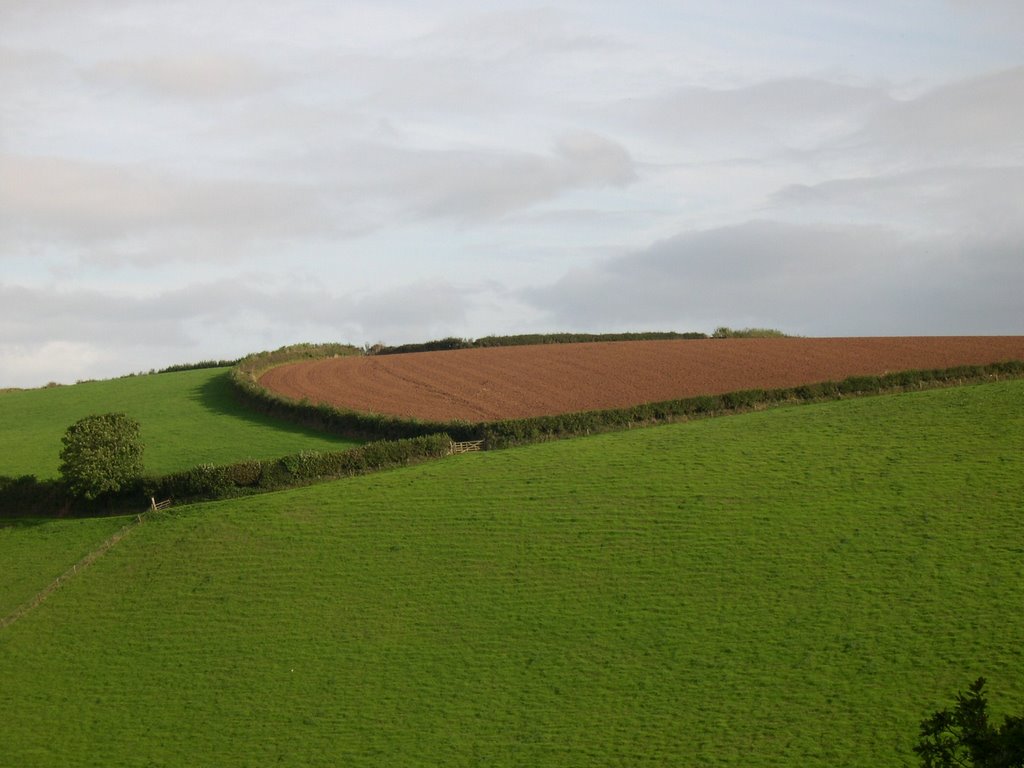
Sure, we all know it rains in Oregon. It's in the Pacific Northwest, for crying out loud. All that rain keeps the rivers running and the trees growing. They have a lot of evergreens, too. Most of California's Christmas trees are grown in Oregon. Jim and I spent a long (and wet) weekend in Oregon recently. We drove past plenty of Christmas tree plantations.
Why Oregon? It is a damn fine place to visit, we have friends there, and Jim has family there, too. Oregon is also high on our list of places to establish a cheese business. It is easier to afford a nice house with some land not too far away from a major metropolitan city. We like the country life, but we don't want to give up EVERYTHING that we like about the big city. Like sushi or Thai food. It is the beaver state!
Jim and I took an exploratory trip to McMinnville, in Yamhill County. We stayed with his uncle Wayne and his wife Linda. McMinnville is about 75 minutes south of Portland on US99. The past few years it has become a hotbed for Oregon wines, along with its neighbor, Carlton. Not a bad thing if you want to sell some cheese, too. We managed to find our way from the Portland Airport to the Harris House with ease. Lunch was waiting and we spent it catching up with Wayne and Linda. We didn't waste anymore time and jumped in Wayne's car and drove off to explore the countryside. We drove around lots of wooded hills and twisty roads. There's a lot to see around McMinnville, so we took our time and took in the countryside.
Yamhill County is farmland. We saw orchards full of hazelnuts, walnuts, and Christmas trees. It was near harvest time so all of the Christmas trees looked like perfect pyramids, ready to harvest and decorate living rooms all over the West Coast. There is also a booming wine industry in the area, so lots of acres are now covered in vines. But it is not a monoculture. There are still plenty of farmers earning a living growing blueberries and grass seed. All of this is about 1 1/2 hours outside of Portland. There are also dairy cows grazing in health pastures. A nice thing to see if I want to make cheese from these contented cows. Now if there are some goat dairies or sheep dairies, I'll be set!
We spent a very pleasant evening at an amazing restaurant in Dayton, Oregon. The Joel Palmer House is run by a husband and wife team, Jack and Heidi Czarnecki. He's not only the chef, he's an avid mushroom forager, too. The fruit of his labors are the focal point of the menu at the Joel Palmer House. Almost every dish features mushrooms in some form or another. The cream of matsutaki mushroom soup was rich and creamy and delicious. The three mushroom tart was outstanding. The chanterelles in a cream sause were cooked to perfection. The "faux gras" was so rich I could barely eat my main course. Our main courses were just as well executed. I had the filet mignon with the porcini sauce. It was the most tender steak I have ever eaten. I could cut it with a spoon. I can't wait to go back and indulge again. Go Jack and Heidi! Jack came out to say hello, as he's Wayne and Linda's friend. Wayne told him why we were in the area and Jack was very happy to hear that I'd want to make cheese in Oregon. He offered several suggestions and was very supportive in general. I'd love to have a cheese featured on his menu. It would be a great honor. He's an amazing chef with a lot of passion behind his menu.
The rest of the weekend we saw many small towns, from Vernonia to Sheridan. That's covers about 100 miles. I think Jim and I were most impressed with the surroundings outside of McMinnville. The rain didn't deter us and it rained a lot that weekend. We'll be back up there soon, I think.
Thursday, November 30, 2006
It Rains in Oregon

Yippee kai yai yo!
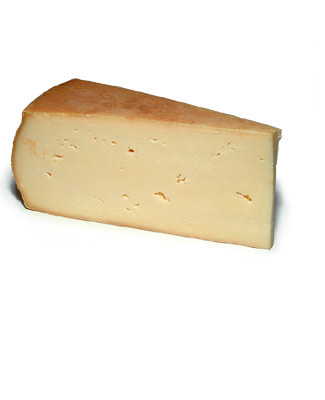
In case you might be wondering, I still work the counter at Cowgirl when I'm needed. This seems to work well for everyone. For me, I can have Saturdays free to spend with my sweetie. For Cowgirl, they have someone they can call upon when they need an extra set of hands and don't need to worry. I worked last Saturday, selling cheese to lots of tourists visiting San Francisco for Thanksgiving. I enjoy the public interaction. If someone wants to try a cheese, I'm happy to let 'em have a taste, and if I haven't tried it in a while, I'll take a taste, too! It is fun to compare tastes with my customers. Usually we both wind up saying "Yum!" and I'll go and cut a wedge of cheese for them on the old Handee cheese cutter.
Lately I've been tasting a lot of cheese. It is like saying hello to old friends. I'll take a tiny taste and the memory of the cheese comes rushing back. Since cheese tastes different from wheel to wheel, I'll have a good idea how this particular cheese adds up. Lately the Midnight Moon (goat milk gouda) has been delightful. It is extra-aged and extra tasty. The Comté Montagne has been off the scale in terms of its flavor. The Abbaye de Belloc has been really rich and nutty, too. Red Hawk has been particularly fragrant and soft. Other favorites lately: Hillman Farm's Harvest Goat, Vermont Shepherd, and French Raclette.
Life is good so long as I can keep working with cheese.
Thursday, October 26, 2006
Aging nicely and the raw deal for raw milk
The caerphilly is aging nicely. It should be ready in a couple of weeks. I have a new Sarahmore drying. Tomorrow I will salt it, let it sit some more and then into the cave it shall go for 3-4 weeks. This is getting to be a habit.
Rant time:
If you're curious about why raw milk and its providers are hard to find, take a look at this editorial about a cow-share program in Michigan that was stopped.
*******************
Business Week editorial:
*******************
States Target Raw-Milk Farmers
Michigan is the latest to bust a provider of unprocessed milk-and its
heavy-handed tactics may put three small farms out of business
by David E. Gumpert
For several months over this past summer and fall, Michigan
authorities tracked Richard Hebron, 41, and his weekly truck hauls the
140 miles or so from Vandalia to Ann Arbor. To gather evidence, an
undercover agent infiltrated an organization that was making private
purchases from Hebron.
On the morning of Oct. 13, the authorities closed the loop on their
complex sting operation. Just outside of Ann Arbor, a state police
officer pulled over Hebron's truck during its weekly run, served
Hebron with a search warrant, and with several other agents began
removing goods from the truck.
Back home in Vandalia, a state trooper accompanied by four
plain-clothes agents knocked on the door of Hebron's home, presented
Hebron's wife, Annette, with a search warrant, and fanned through
their small three-room house, removing their computer, business
records, and product samples. Later that afternoon, in Ann Arbor, four
additional agents, also armed with a search warrant, rummaged through
a warehouse that was Hebron's destination when he was pulled over,
seizing more business records.
Expanding Investigation
The trigger in this huge investigation? No, it wasn't drugs, stolen
goods, or terrorism. It was, of all things, raw milk and its various
byproducts, including cream, buttermilk, yogurt, butter, and kefir.
The Michigan Agriculture Dept., which oversaw the investigation
together with the Michigan State Police, sees the situation as a
simple matter of enforcing the law. Unfortunately, when it comes to
raw milk, the law is no simple matter.
"We've had an investigation for several months now," says Katherine
Fedder, director of the Michigan Agriculture Dept.'s food & dairy
division. The investigation, she says, began with a report from a
local public-health department last spring about children who had
become sick who " had consumed unpasteurized milk." She noted, though,
that the children's illness was never traced back to raw milk or any
other specific food. In any event, a department inspector joined the
co-op to purchase milk and expand the investigation.
"Our concern is that there's a violation of the Michigan law to
distribute misbranded products and unpasteurized dairy products out of
an MDA-licensed food establishment," Fedder says, adding that the
investigation of the computers, records, and milk products confiscated
will likely take "a few more weeks before we have a clarification."
Then, Hebron and/or the co-op could be charged with "a whole variety
of things" under a Michigan food law and a dairy law.
Crippled Co-op
Hebron is a farmer with about 110 acres, where he raises beef, cattle,
and chickens. He also manages the four-year-old Family Farms Co-op
with two other farm families, through which all three farmers sell
their products at the Ann Arbor outlet, as well as two outlets in
Detroit and seven in Chicago.
One of those farm families, an Amish couple with eight children, owns
the 70 milking cows that produce the cooperative's raw milk (milk that
isn't pasteurized or homogenized). The Amish farmer doesn't have a
phone or other modern conveniences and couldn't be reached. Hebron
says the farmer has requested Hebron to speak both on the co-op's and
the farmer's behalf and not to publicize his identity. This farmer is
essentially out of business for the time being, and has had to throw
out all his milk produced since Oct. 13.
The entire co-op is crippled, since the farmers are without their
computer, fax, or business records. And already three Chicago retail
outlets, unsettled by news of the Michigan officials' actions, have
told Hebron not to bother returning with additional products. "This is
what we do for a living," says Hebron. "We don't get unemployment
checks."
The experience has left the Hebrons shaken. "They treated us pretty
much like we were drug dealers," he says. Moreover, it's not clear if
any of the co-op members will be charged with a crime and when the
co-op may be able to resume its normal business.
Worse than Russia?
The Family Farms Co-op thought it had dealt with the Michigan
prohibition against retailing raw milk, which is similar to
prohibitions in many other states, four years ago, when it set up the
co-op. Under the arrangement, the co-op leases cows from the dairy
farm and then sells shares in the herd to co-op members, each of whom
pays $20 a year for their share. The co-op members purchase milk for
$6.50 a gallon, which goes back to the dairy farmer in the form of a
boarding fee for the cows.
"It has to be this way, because it's illegal to sell raw milk retail"
in Michigan, says Hebron. Michigan law allows for people who own and
board dairy cows to consume their milk, though.
After I listened to Hebron tell his story about the state police and
agriculture inspectors refusing to let him make a call home after
confiscating thousands of dollars worth of fresh farm products from
his truck, and then serving a search warrant on his wife and rummaging
through the farm family's home, I asked him, "Could you believe this
was happening in the United States?"
"No," he said. "I have a customer in Chicago who says he's from
Russia. He thinks this is worse than what happens in Russia."
Crackdown Factors
This harsh Michigan action bears an eerie resemblance to the case of
Organic Pastures Dairy, a producer of raw milk, which California
agriculture officials shut down for more than two weeks (see
BusinessWeek.com, 9/28/06, "Getting a Raw Deal?"). California
authorities went after Organic Pastures when four children became sick
from E.coli bacteria, but an exhaustive investigation turned up no
evidence of E.coli at the dairy. In comparison, even though 200 people
were sickened by E.coli from California spinach, none of the
California spinach farms were shut down.
What's behind these crackdowns by major states against producers of
raw milk? I suspect it's a combination of two forces at work.
First, there's the simple matter of growing demand from consumers
seeking food with as little processing as possible, who want to buy it
from local farm producers (see BusinessWeek.com, 10/16/06, "The
Organic Myth"). Organic Pastures has seen its revenues climb 35% to
40% annually since it switched to selling raw milk in 2000. Similarly,
the Family Farms Co-op has grown from nothing to nearly 1,000 members
over the last four years.
Out of Proportion
Second, as raw milk and organic milk (milk which is pasteurized, but
obtained from cows fed organic feed, with no hormones) become more
popular, large dairies are becoming concerned and exerting pressure on
agriculture officials to crack down on the raw-milk producers. Just
take a look at the Web site milkismilk.com to get a sense of the
conventional dairies' concern.
Regardless of what anyone may think about raw milk, the heavy-handed
enforcement action by Michigan authorities just feels
inappropriate-way out of proportion to any possible violation of the
law. It smacks of a speed-trap approach to law enforcement, except
here the penalty isn't just a fine, it's the livelihood of three
family farms.
(Note: I will be following the unfolding situation at Family Farms
Co-op, much as I have the Organic Pastures situation, at my blog,
thecompletepatient.com.)
Gumpert is author of Burn Your Business Plan! What Investors Really
Want from Entrepreneurs and How to Really Start Your Own Business. His
Web site is www.davidgumpert.com.
Monday, October 23, 2006
Fin de Semana de Queso
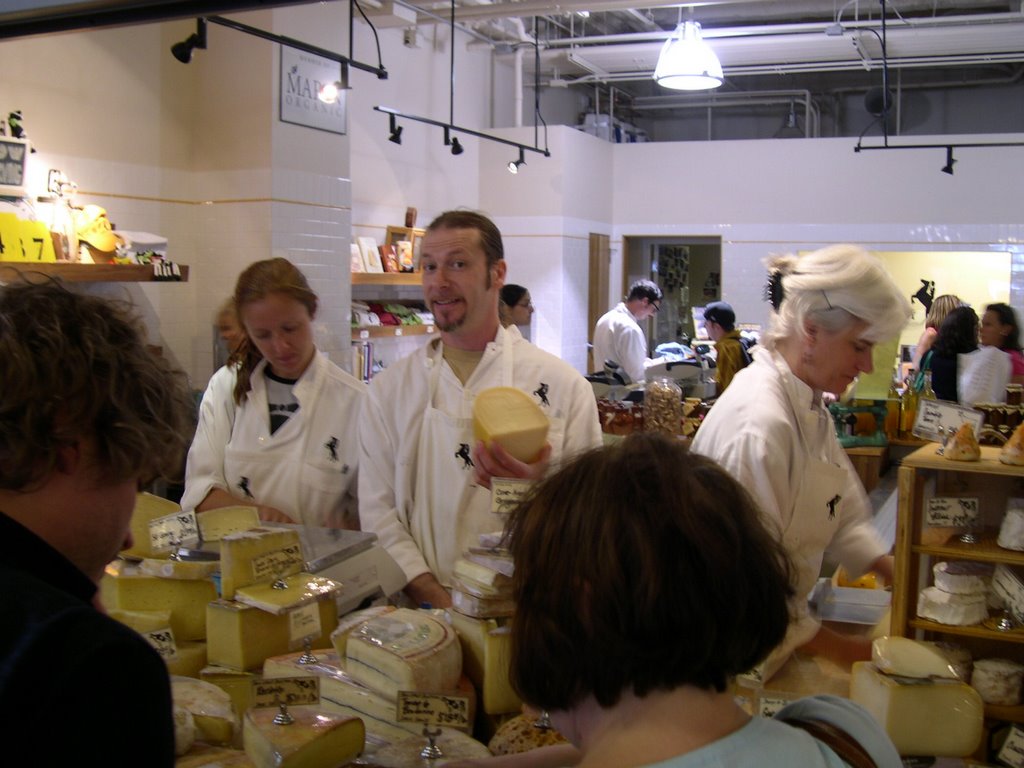 A glimpse of Cowgirl on a Saturday in August. Stephanie, Daniel, and Janet working the crowd. Janet has moved to DC to work at the new shop on F Street. Stephanie wears many hats. Check out her blog The Grub Report.
I had a very cheese-filled weekend. I spent Saturday morning working from 8:00am -2:30pm working at Cowgirl Creamery. I called it a guest appearance. Several of my fellow cheesemongers asked if I was coming back for good. I love cheese. I love selling cheese. The customer interaction is really gratifying. I feel like the cheese fairy, spreading happy cheese blessings where ever I go. Offering tastes of creamy goodness to people who are eager to try something new. I like to share my passion. Returning to the cheese counter is fun for me also, because there are new cheeses! Yet, I get the most pleasure out of making cheese.
There is a new Cowgirl Cheese called Inverness. It is a "lactic" cheese and a work in progress. It has a bloomy rind like Mt. Tam, but it has a lighter texture. It is shaped like a large, white thimble. The taste is slightly tart, and dissolves on the tongue with a creamy finish. This is a style of cheese that I'm still trying to figure out. Lactic cheese is a type of fresh cheese but it is also used as a descriptive term. Starter culture and a little bit of rennet is added to warm milk and left to sit for several hours (usually overnight). The milk turns into a thick yogurt consistancy. This curd is not cut but poured into a colander lined with cheesecloth. The four corners of the cheesecloth are tied together and the curds are left to drain for several hours. Since the curds are not cut, less whey is expressed and the cheese is very soft and spreadable. It is used like cream cheese or fromage blanc. Cowgirl's is left to age until a bloomy rind has grown. P. candidum must be added to the milk or sprayed on to the young cheese and left to age for a couple of weeks. I'm just guessing. I haven't been to the creamery to ask.
But I digress. Other new cheese: Two from Vermont Butter and Cheese company, soft spreadable goat cheeses with funky rinds. They come in cute little wooden trays. Jasper Hill Farm in Vermont has a new blue cheese, similar to a stilton. Fun! There is a fresh sheep's milk cheese from Wisconsin in the fresh case. Similar in texture to a fresh chevre, but it is more mild and has a rich, slightly sheepy(?) finish. I like it.
Also new to Cowgirl, more cheese from Vermont: Willow Hill Farm. They are an organic sheep dairy, who also sell fresh lamb, wool, blueberries, blankets in addition to sheep's milk cheese and yogurt. Cowgirl is carrying Vermont Brebis and Alderbrook and their yogurt. Both cheeses are cave aged, bloomy rinded and very runny. I have a Brebis that I need to try. It looks like a small camembert and feels very soft.
I can't wait to try it this afternoon. I think I'll get a loaf of french bread and a spoon. It is quite ripe.
By the way, Jim has put me on notice. No more cheese can enter the house until we finish what we have. I've been on a spending spree it seems. I can't go into a market without examining the cheese section thoroughly. I call it research. Jim calls it overkill. "Enough, dear. No more cheese for the rest of the month," he said last week. "But, but....O.K. I guess the fresh goat cheese log from Spain, the wedge of Basque sheep/goat tomme, Parmiggiano Reggiano, cave aged gruyere, my own Faux Ticklemore - now called Sarahmore (thanks Cynthia!) and my own fresh chevre are enough. I'm not counting the overripe little morsels of soft, French sheep's milk cheese, nor the tiny reminants of Harbourne that are still floating around in the veggie drawer. The promise went by the wayside after Saturday's stint at the shop. I had to try that Vermont Brebis. I've also got some Straus yogurt in my fridge as well as Bellwether Farms Creme Fraiche. There are two gallons of Clover milk waiting to be turned into cheese. I do my best to support the dairy industry. If you follow the Clover link, look at the billboards on Clover's website and check out 1989. A few of my favorites are there, especially #3.
Sunday we drove down the San Mateo coast to Half Moon Bay. It is pumpkin season. Jim and I love roaming around pumpkin patches to find the "right" squash to turn into jack-o-lanterns. The more misshapen the better. We've had good luck at Bob's Pumpkin Patch in the past. The have acres of them and you can even pull them off of the vine. This year produced some good ones. We've found a huge, pear shaped squash that's still kinda green. We yanked it off the vine and put it into the wheelbarrow. Soon five more orange pumpkins were added to the wheelbarrow. We're ready for Halloween now! It was around 2:30, too early to head home, so we drove 20 minutes south to Pescadero to grab some soup and olallieberry pie at Duarte's (pron. Doo'-arts) a tavern that specializes in cream of artichoke soup, fresh seafood and pie. Their cream of chile soup is amazing, too.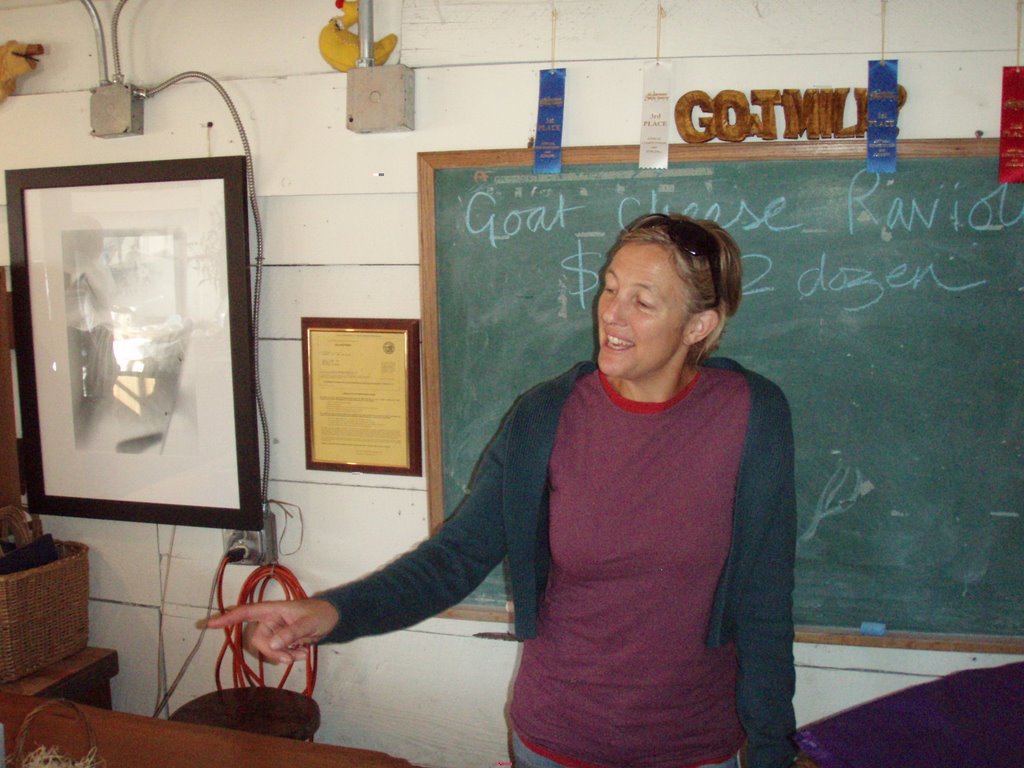
Since we were in Pescadero, and I wasn't that hungry yet, I suggested we drive over to Harley Farms, a farmstead goat cheese maker. It is on the edge of town (three blocks from "downtown") in Pescadero. We drove up to the the farm and they were open. Yay! The goats were casually walking around the pasture and checking out the tourists near the gate. We went into the barn which is Harley Farms' shop and make room. Next door is the milking parlor. There are large windows to allow for plenty of light and lets folks watch the exciting work of milking goats or making fresh goat cheese.
Inside the shop, Dee Harley was selling her cheese and swatting flies. A big, grey cat was dozing in a patch of sun on the floor. We entered the small storefront and sampled Dee's assorted cheeses that lined the counters. They were hidden under cheesecloth to protect them from flies and the sun. We sampled her chive logs, goat ricotta, fromage blanc, and other delicious goat cheeses. Locals came in and grabbed their weekly supply of fresh cheese, paid and left. We bought a tub of fromage blanc and chatted with Dee. She's going to the Slow Food Terra Madre gathering in Turino, Italy this week. The Slow Food gathering is getting to be quite the shindig. Cheesemakers (and others) from England, the USA, and I'm sure most of Europe decend on Italy to meet and talk about sustainable food production and issues like EU and FDA regulations that kill traditional methods of food preparation. A lot of eating happens. I have seen photos of multitude of cheeses to try. I'd like to go someday, but I'd like to have something to show for myself. Slow Food's Terra Madre is to the food scene as South By Southwest is to the music world. Everybody shows up and people enjoy themselves. 600 international cheeses vs. 600 international bands. Dee was excited to be going and representing American cheesemakers (even though she's English).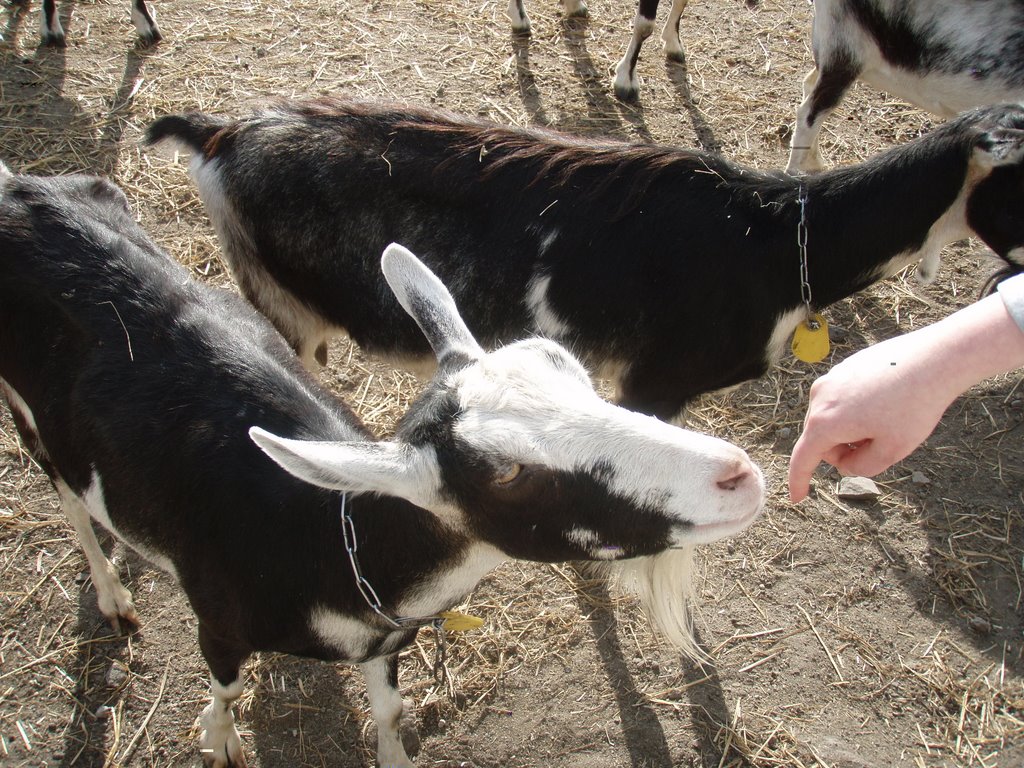
We talk to Dee for a while. I told her that I've been making cheese at home and abroad. She was very supportive and gave us lots of advice. We really hit it off with her. She invited us to go and say hello to her 200 goats. How could I resist? We walked through the gate and were greeted by some very friendly Alpine does. The stinky billy goat was walking around making sure his girls were happy. We scratched ears and talked to the girls. It was a nice way to spend an hour. Dee invited us back in the spring when the kids are around and the milk is at its finest.
We'll be back!
Monday, October 16, 2006
We have a cheese!
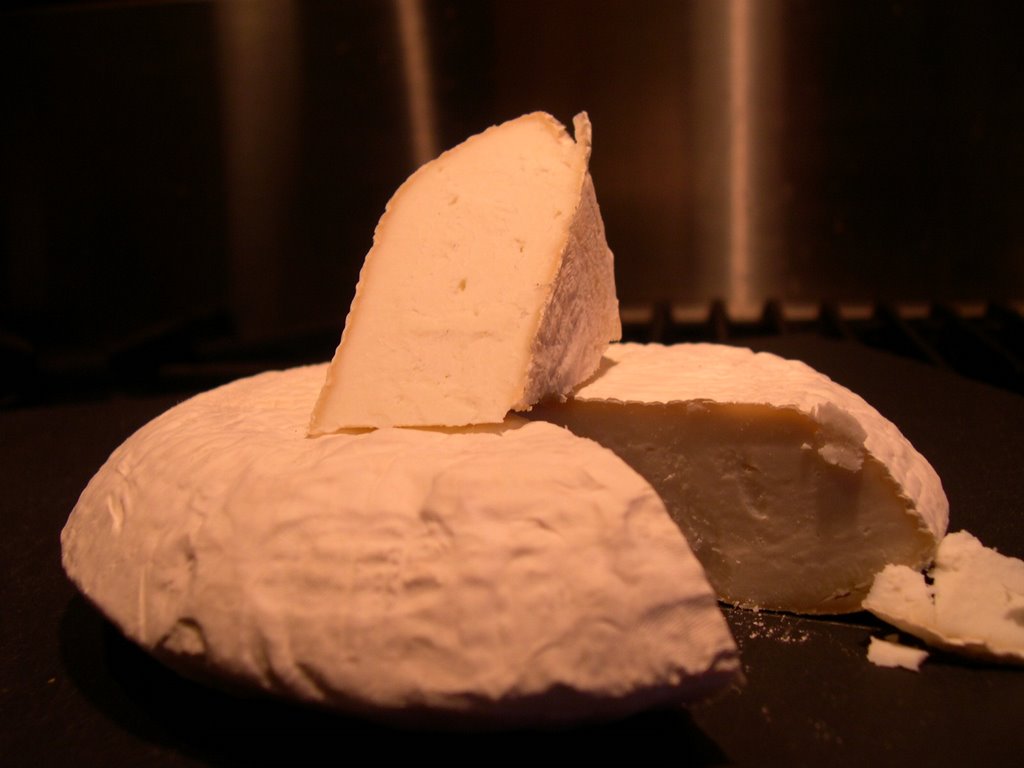
Yippee! We have success! The faux Ticklemore Goat, is out of the cave. Jim and I broke into it last night. Jim was taking the recycling downstairs when I was about to cut into it. "Wait!" he shouted. "I want to be here for this!" OK. I waited. I grabbed my handy IKEA cheese hatchet for the big event. While I was waiting for Jim, I examined the small disk of cheese. The wheel feels harder than I had anticipated. There is very little give. It definitely looks edible. It smells edible, too. Slightly earthy, like a button mushroom. Jim arrives back in the kitchen and I take the knife and cut the cheese. It cuts through the disk easily enough but I can tell it is a hard cheese, beyond firm. I make another incision and pull out a wedge of cheese from the wheel. It looks like a small, white slice of pie. Jim and I look at it. It has perfect rind formation. There is a nice layer of p. candidum dusting the rind. There are a few tiny eyes in the body of the cheese. I break a piece off of the wedge. It snaps apart. Ah. Way too hard. I smell. It is slightly goaty and clean smelling, still with a hint of white mushroom. Good. We taste it.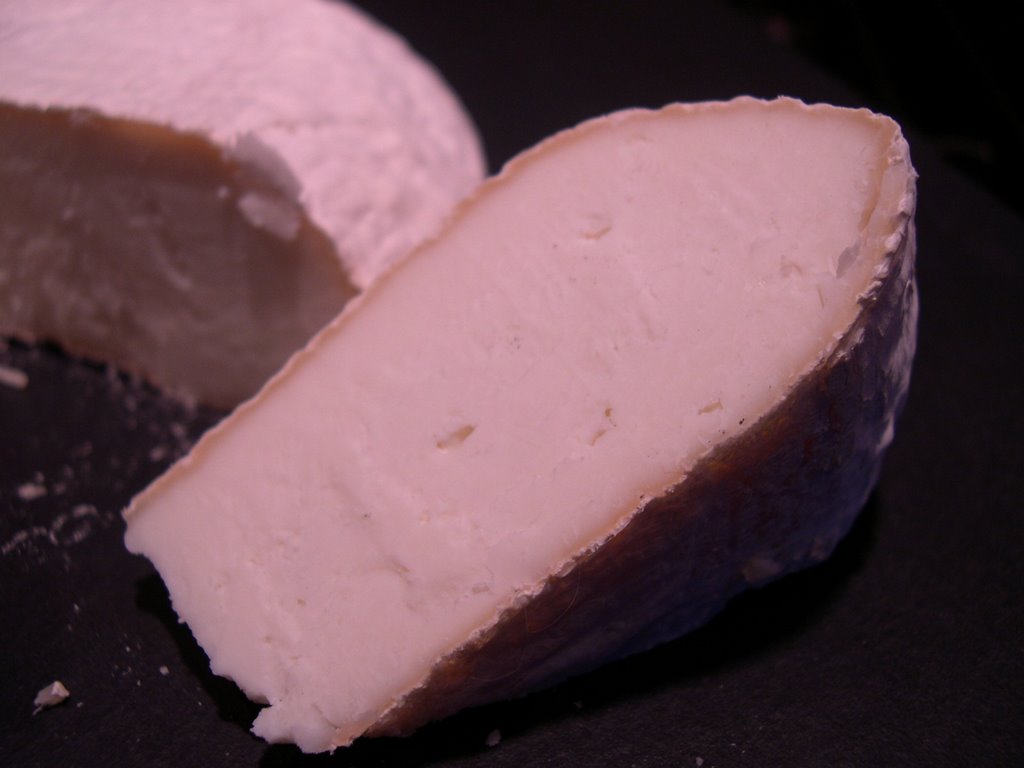
It is good! The texture is too hard, but the flavor is there. Mild and mushroomy, but has slight citrus overtones. I really like it. I'd make it again, with some alterations. I'd cut the curds a bit larger. I'd stir it more gently, perhaps with my hand. Now I get to tinker with the recipe. This is why it is critical to keep notes on your make procedure. What did I do last time? What should I change this time? Yay!
Last week I made another cheese. I really like caerphilly, a cow's milk cheese from Wales. I have recipe for it in one of my many cheese books so I thought I'd give it a whirl. I procured two gallons of non-homoginized milk from Other Avenues and Trader Joes. Other Avenues carries Straus Family Creamery milk. TJ's has their own "cream top" organic milk from Northern California. I thought I'd give them a taste test. Straus milk is in glass. TJ's milk is in plastic. Straus tasted better hands down. I think it is the fact that plastic adds a flavor to milk. Glass adds no off taste. Straus, however is now bottling their milk in plastic, too. I'll have to try this comparison again with each milk in plastic bottles. Taste test over, I made some cheese.
I had to leave it to dry on the counter for several days. Now it is in the fridge, aging for three to six weeks. I'll see how long I can wait.
Friday, September 29, 2006
One week hence

I have been home for over a week now. How have I spent my time? I made cheese, of course!
I came home and went right to work. I had to make sure I remembered everything that I learned while in Devon.
Before I could make cheese, I needed to consider how I might age it. I can't just leave it out for the cats to sniff, and it needs to be kept in a cool, humid environment. I need a cheese cave.
I lack anything close to cave like conditions in my Sunset District home. They don't build basements in homes built on ancient sand dunes. Like most American homeowners, I DO have an extra fridge in the garage. When we remodeled our kitchen, the old fridge went to live downstairs, just inside the garage. Jim claimed it as his beer and soda fridge. During the holidays it masquerades as a legitimate refrigerator. Well my plans now include putting this extra power drain to good use. A few months ago I bought a device that overrides the refrigerator's thermostat and raised the operating temperature to proper cave temperature. Most fridges don't like to hang out at 50-55 degrees. So I plugged the gizmo in and put copper sensor rod in the fridge. I monitor the temp inside the fridge via a thermometer that registers temps as well as humidity. Now I'm playing with pans of water in the fridge to keep the humidity up. A fridge is a natural dehydration chamber, so keeping water in something that lets it evaporate into the air in it is critical for proper cheese maturation.
Jim came home, went into the garage to start a load of laundry and came upstairs with a puzzled look. "What did you do to the fridge?" he asked. He's quick, I'll give him that. I know he knew the answer, but I humored him. I gave him a big smile and said, "I converted it into a cheese cave."
Pause.
"Oh," he said. "What about the stuff in the fridge?"
"It's only soft drinks and beer. They can stay in there so long as I'm not aging cheese. They'll be kept a bit warmer, that's all," I said trying to comfort him. "And besides, you wanted to get rid of it."
"But that was before I put beer and soft drinks in there." He just shook his head and knew he couldn't win this conversation. I now have my cheese cave.
Back to the cheese. I got home on Wednesday. Thursday was spent doing laundry and shopping. I had to restock our real refrigerator. Wednesday night I discovered a roasted chicken breast that was left over from a meal five weeks ago. It had turned blue and smelly. Toss. I also tossed a few other nasty looking specimens. I guess Jim didn't go through the fridge while I was away. Off to the Serramonte Farmer's Market on Thursday. Stocked up on good fruit and veggies. Also made a Trader Joe's stop and got some goat milk. They carry a brand that's NOT ultra-pasteurized. Critical for cheesemaking.
Friday I made cheese. I tried to do a modified Ticklemore Goat. It is hard to replicate the conditions of the make room and aging rooms at Ticklemore because I can't just throw water on the floor and have the room temperature kept at appropriate aging temps. I've got to live here! So I dry the young cheese in the kitchen and then moved it to the cooler office downstairs. I put it into a large cardboard box to keep the humidity up. I also have placed a couple of clean, wet cloths in cups of water to wick up moisture and release it into the box as well. Hopefully this will keep the air humid enough for my cheese.
The photo above shows it when it was a few hours old. The image below is the cheese at one week of age. We have achieved fuzz! P. Candidum to be exact. Three more weeks to go! The cheese went into the cave yesterday.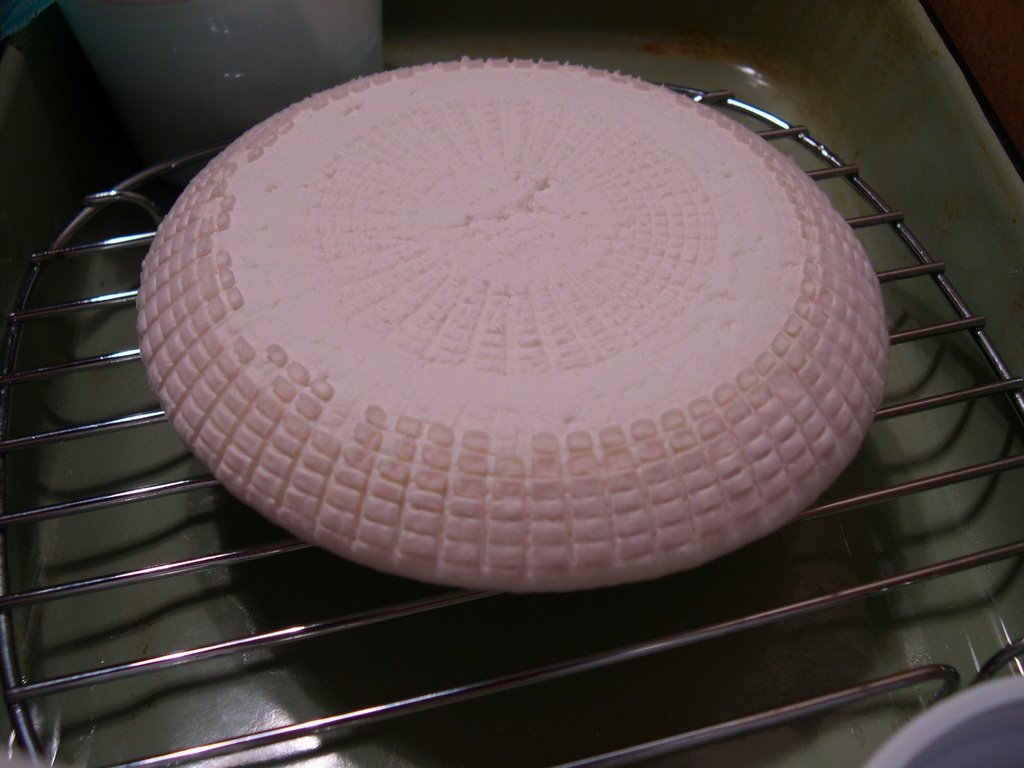
My other project: I'm starting to write a business plan. Gotta get these ideas out of my head and onto the illuminated page.